
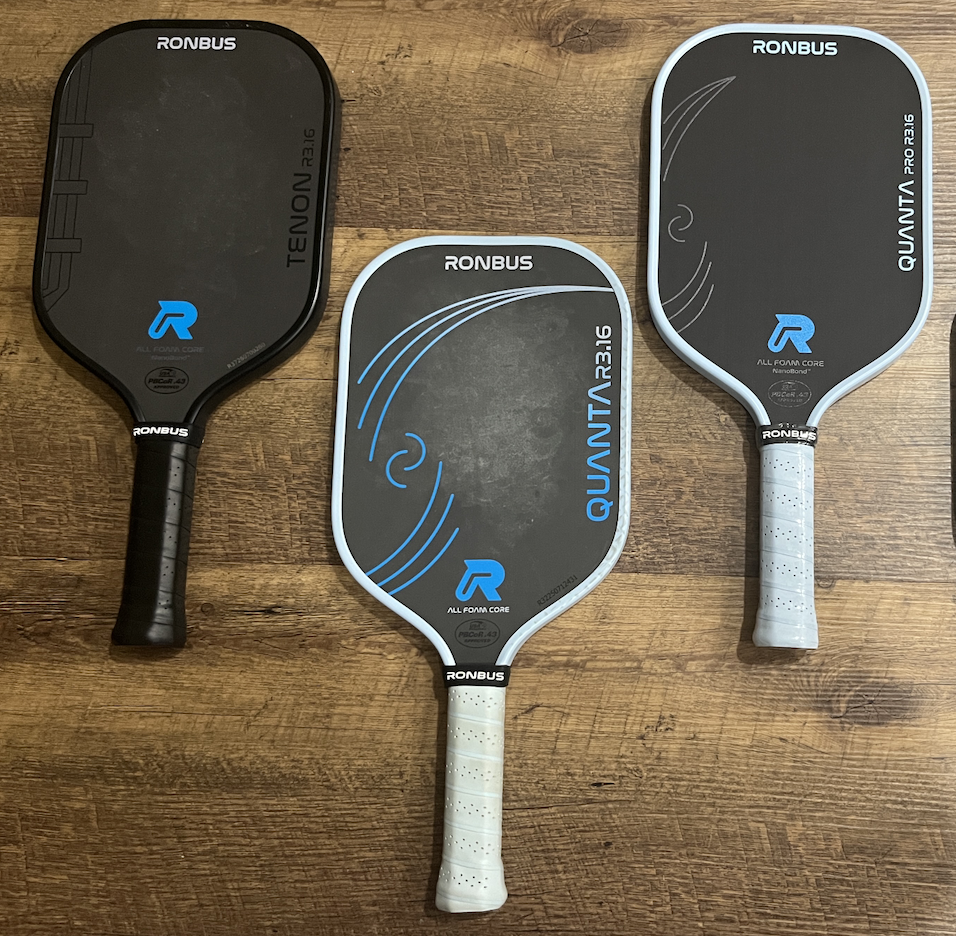
The Ronbus Quanta Pro is releasing this Friday on August 28th, and I was so excited that the Ronbus team was generous enough to allow me to test the paddle and review it before releasing to my readers to give you a first look.
The new Quanta Pro takes the power of the Quanta with the goal to elevate with with long lasting spin and stability.
The paddle did not disappoint, so let me cover first impressions, the playability, cost coonsiderations and how to use the code PICKLEBALLER for $20 off and whether you should purchase the new Quanta Pro.
First Impressions
Let’s look at the new Ronbus Quanta Pro. It comes in 3 different versions, including the R2, R3, and R4, which includes the wide body, the elongated and the hybrid versions. What is interesting to note in the line up is the absence of the R1 model (elongated with curved top) in the Quanta Pro.
The paddles are absolutely beautiful, and I love the grit on each of these paddles.
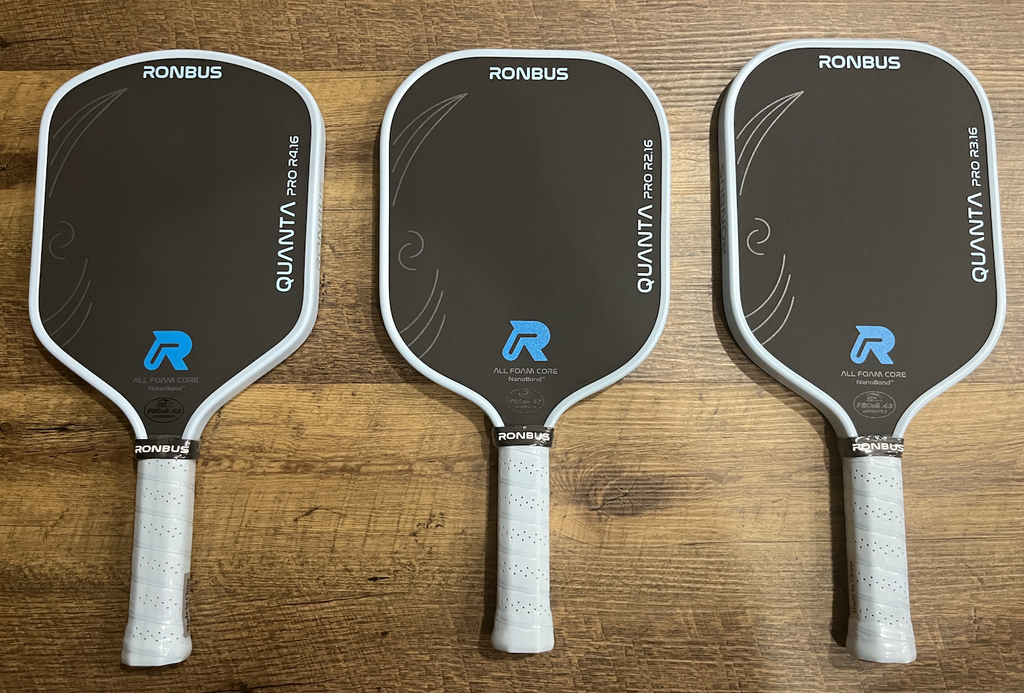
Here are the specifications.
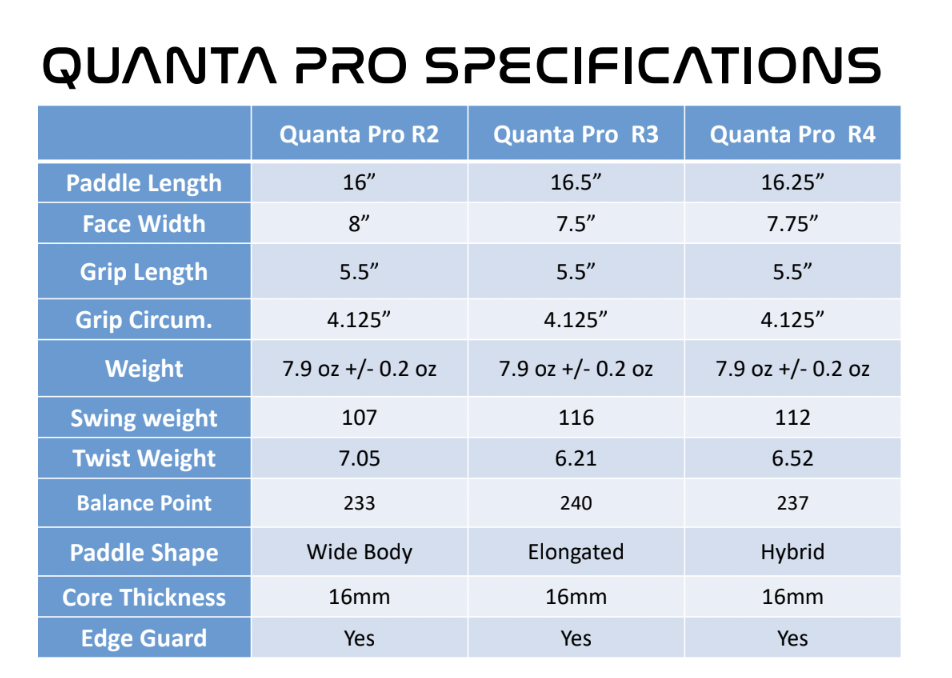
What I found really interesting is the weight difference between the new Ronbus Quanta Pro and the Ronbus Quanta.
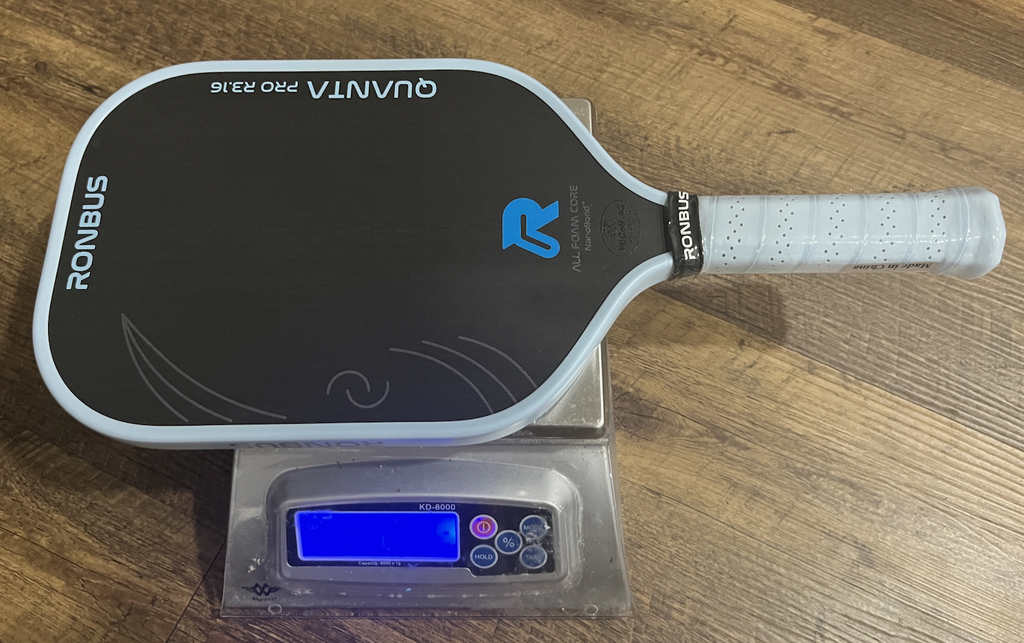
I added weight to my Ronbus Quanta as it was 7.75 ounces before adding weight and then 7.95 ounces.
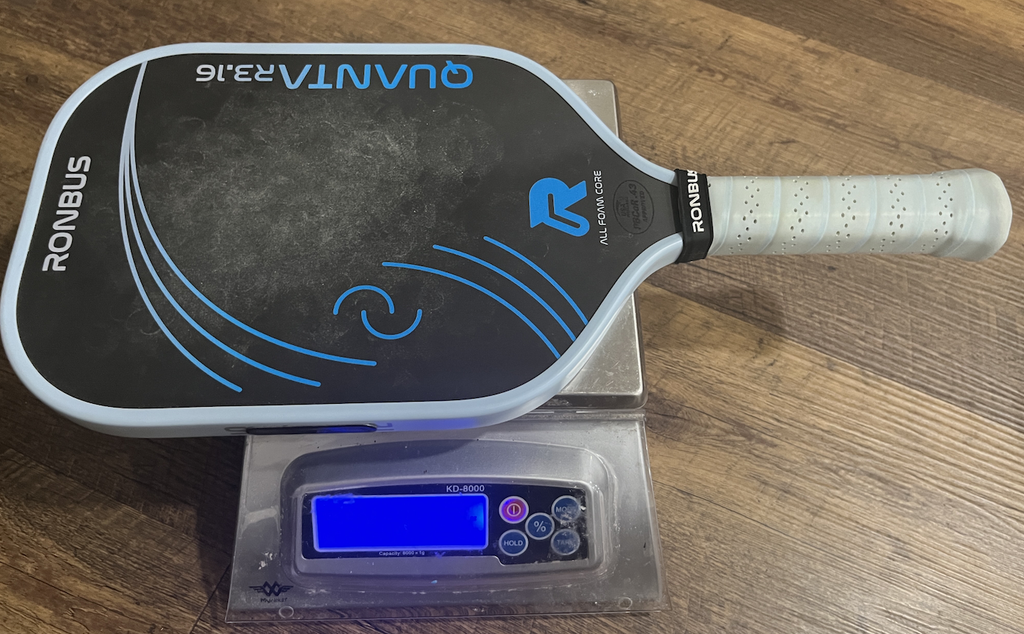
The Ronbus Quanta Pro R3 started at 7.95 ounces, so I didn’t actually add any weight as it was around the 8 ounces that I like when using a pickleball paddle.
Let’s talk about playability as this is where things really heated up.
Playability
Firstly, let’s look at the side by side comparison of the larger changes spec wise between the Quanta and the Quanta Pro.
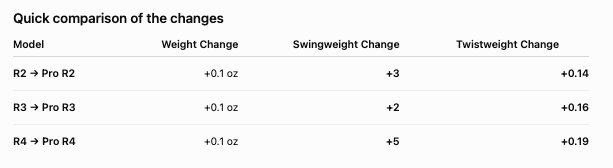
What stands out immediately is that every Quanta Pro model has a slightly higher swingweight and twistweight than the standard Quanta version.
That generally means the Quanta Pro should feel a little more stable, have greater plow-through, and resist twisting more when you make contact away from the center of the paddle.
The standard Quanta paddles are still going to feel a little quicker through the air, but the Quanta Pro feels more substantial and more planted.
Let’s see if that increased stability and greater plow-through came through in my games with these paddles.
Spin
The spin was one of the things I was most excited to test with the Quanta Pro because Ronbus specifically designed this paddle with longer-lasting spin in mind.
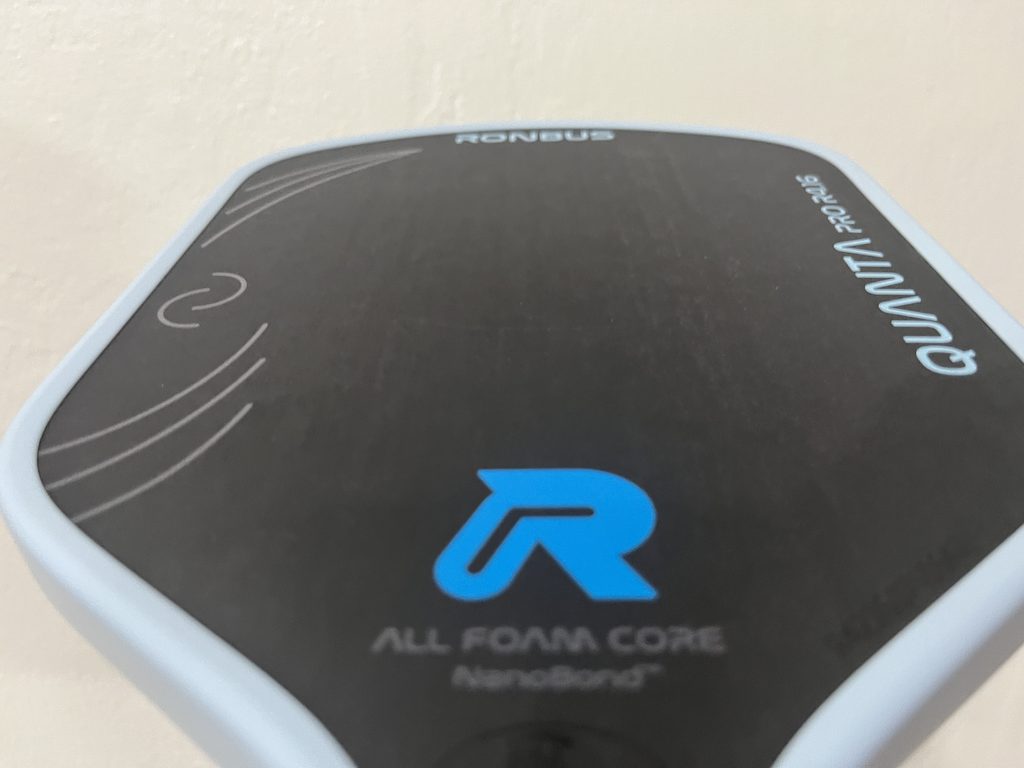
The surface has a very noticeable gritty texture, and you can feel it immediately when you run your hand across the paddle.
More importantly, I felt like the paddle really grabbed the ball well when I was hitting topspin drives, serves, and rolls.
I was able to get very good shape on the ball, and the spin felt consistent across the face.
I especially noticed this when trying to dip the ball at an opponent’s feet or roll the ball aggressively from the kitchen line.
The Quanta already had very good spin, so I don’t think the Pro suddenly transforms it into an entirely different paddle. Instead, the bigger story here is that Ronbus appears to be trying to maintain that spin performance for longer.
Check out a picture of the grit below.
Control
I was also impressed with the control.
Even though the Quanta Pro has slightly more mass and plow-through than the standard Quanta, I did not feel like it became difficult to control.
I still felt very comfortable hitting resets, drops, dinks, and softer shots around the kitchen.
The added stability actually helped me on blocks and resets because the paddle did not feel like it was getting pushed around as much when I was defending against harder shots.
That is probably one of the biggest differences I noticed between the stock Quanta and the stock Quanta Pro.
With my original Quanta, I added weight because I wanted a little more stability and substance.
With the Quanta Pro R3, I did not feel the same need to immediately add weight.
It already felt much closer to the approximately 8-ounce setup that I personally prefer.
Power
Power is where I think the Quanta Pro separates itself a little more clearly from the standard Quanta.
The standard Quanta is already a powerful paddle, but the higher swingweight of the Pro versions gives you a little more plow-through when you accelerate through the ball.
I felt like I could drive through the ball more easily, especially from the baseline and on aggressive counters.
The ball simply felt a little heavier coming off the paddle.
The difference is not enormous on every model, though.
The R2 Pro only increases from a 104 to a 107 swingweight, while the R3 goes from 114 to 116.
The biggest change is actually the R4, which jumps from a 107 swingweight on the standard Quanta to 112 on the Quanta Pro.
That is a much more meaningful increase and should make the R4 Pro feel noticeably more powerful and planted than the regular R4.
Cost Considerations
The new Ronbus Quanta Pro and the Ronbus Quanta are both $119.99, but with the discount code below you can save $20.
That brings the price down to $99.99, which I think makes the Quanta Pro especially compelling.
At essentially $100 after the discount, you are getting a paddle with excellent spin, strong power, good stability, and three different shape options.
$20 Off Discount Code: PICKLEBALLER
Should You Purchase The Ronbus Quanta Pro or Quanta?
loved the new Ronbus Quanta Pro, and I absolutely would choose the new Ronbus Quanta Pro if you want more stability out of the box and slightly greater plow-through and power.
I also appreciated that I could play with the stock Quanta Pro more easily than with the stock Quanta
With my standard Quanta, I ended up adding weight to bring it closer to the feel I wanted. The Quanta Pro R3 was already approximately 7.95 ounces out of the box, so I was able to play it completely stock.
That said, I don’t think everyone automatically needs the Pro. If you prioritize extremely fast hands and the lightest possible feel, the standard Quanta may actually be preferable.
The Quanta Pro makes the most sense for players who want the same general Quanta DNA but with a more stable and substantial feel.
But, Which Quanta Pro Shape Is Best For You?
If I had to simplify the entire lineup:
Choose the R2 if you want the fastest hands and most forgiveness.
Choose the R3 if you want the most power, reach, and plow-through.
Choose the R4 if you want the best balance between the two.
For most players who aren’t sure which shape they prefer, I would probably start with the Quanta Pro R4.
For doubles-focused players who want maximum stability without a high swingweight, I’d lean toward the R2.
And for aggressive players, singles players, or former tennis players, I’d lean toward the R3.
At $99.99 after using code PICKLEBALLER, I think the Ronbus Quanta Pro is going to be an extremely competitive paddle.
Finally, ifyou are considering other Ronbus paddles, the Tenon is an extremely fun paddle to consider.
Leave a Reply